Research
I work on LHCb, one of the four big experiments at CERN’s Large Hadron Collider. My research sits where precision physics meets statistics, machine learning and software. Each topic starts with a plain-language summary; open More details for the technical side.
Weighing the W boson
The W boson carries the weak nuclear force. The Standard Model predicts its mass very precisely, so measuring it precisely is one of the sharpest tests of the theory: a mismatch would point to particles or forces we have not yet discovered.
When a W boson decays to a muon and an (invisible) neutrino, the muon’s momentum transverse to the beam piles up just below half the W mass, then falls off sharply. The position and sharpness of that edge, the Jacobian peak, encode the W mass. Measure the spectrum precisely, and you have measured the mass.
LHCb sees W bosons produced at small angles to the beam, a region the other LHC experiments do not cover. That makes its measurement complementary to theirs and helps reduce the uncertainties of an LHC-wide combination.
My role- PhD (2020–24): led the first LHCb measurement of the W → μν cross-section as a function of the muon’s transverse momentum, using 2017 data at √s = 5.02 TeV.
- Developed a two-step approach to the W mass: first publish a detector-corrected spectrum, then extract mW from it. The spectrum stays reusable for new theory and for combinations, and other experiments are now adopting the approach.
- Now: lead analyst for the measurement using the full Run 2 dataset at √s = 13 TeV, extended to a double-differential measurement in transverse momentum and pseudorapidity, with improved momentum-scale and lepton-isolation calibrations.
More details
- Why does mW matter now?
- In the global electroweak fit, the precision on mW is the limiting factor. At the current level of precision, measurements probe quantum loop corrections, including possible contributions from physics beyond the Standard Model. The spread among recent measurements makes new, independent ones particularly valuable.
- What is different about this approach?
- Instead of fitting mW directly to reconstructed-level templates, we unfold the muon pT spectrum to a detector-corrected cross-section in bins of (pT, η), not η alone. Theorists can then fit mW with their own predictions without having to model the detector, and the result can be reinterpreted and combined later.
- Why start at 5.02 TeV?
- The 2017 low-pile-up run at √s = 5.02 TeV was the proof of principle for background subtraction and unfolding in this channel. The Run 2 13 TeV dataset brings far more W bosons and with them the precision needed for a competitive mW.
- Related calibration work
- Momentum-scale biases are among the dominant systematics. I contributed to LHCb’s pseudomass method for curvature-bias corrections (JINST 2024).
Statistics, machine learning & quantum computing
A measurement is only as good as its statistics. I develop methods that extract more information from the data and make results more trustworthy, and I help bring new techniques, from machine learning to quantum computing, into a large collaboration.
My role- Co-developed a new maximum-likelihood method for template fits that correctly accounts for limited simulation statistics. It is implemented in the widely used iminuit fitting package.
- Coordinator of Innovative Analysis Techniques (LHCb DPA WP4) since 2025: I run a monthly forum where internal and external experts introduce new machine-learning, quantum-computing and statistical methods, and I review high-profile papers in this area.
- Supervise Warwick URSS summer projects on conditional normalising flows for muon reconstruction and detector calibration, and on quantum algorithms for classification and tracking.
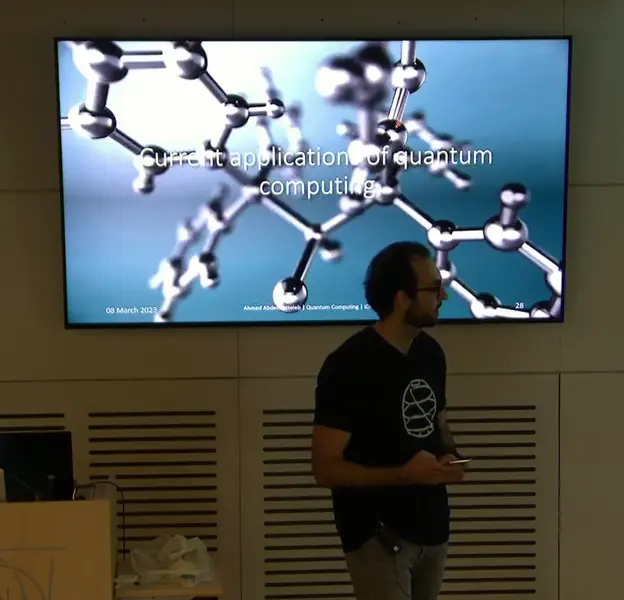
- Initiated the LHCb–CERN Quantum Technology Initiative collaboration, which gives LHCb access to IBM Quantum hardware. I organised the first LHCb Quantum Computing Workshop at Warwick and co-organised the LHC Quantum Computing workshop.
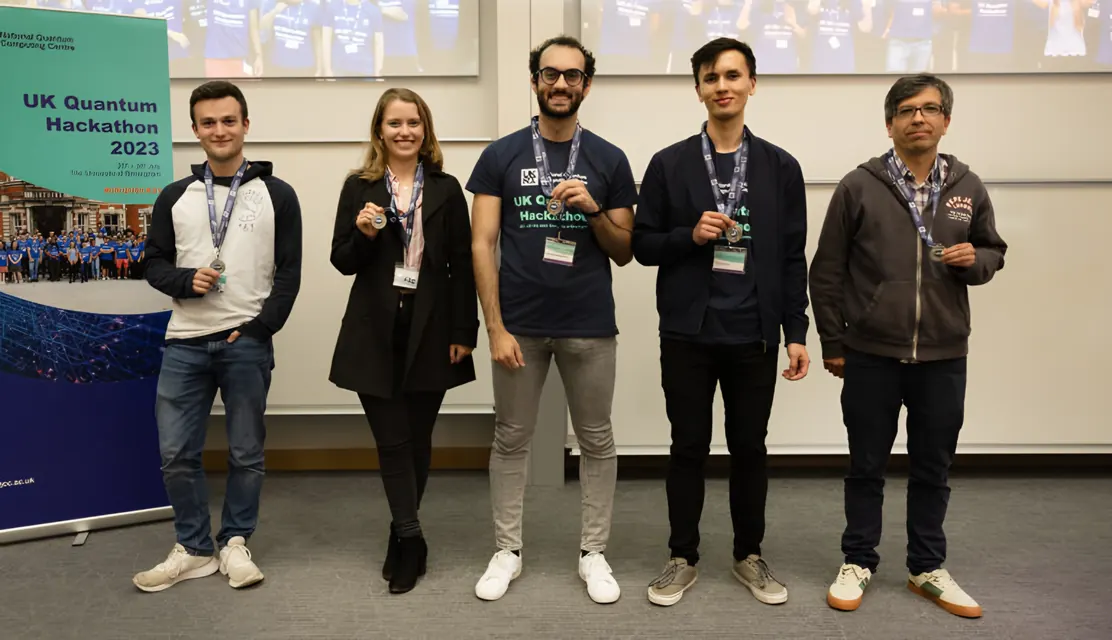
- Second place at the UK Quantum Hackathon 2023 for a quantum Monte Carlo particle-transport simulation for nuclear shielding.
More details
Template fits. Fitting binned templates from Monte Carlo to data should propagate the templates’ own statistical uncertainty. Barlow and Beeston’s exact likelihood does this but is hard to solve and does not handle weighted samples. Our approximate likelihood (Dembinski & Abdelmotteleb, EPJC 2022) generalises to weighted templates and weighted data, with small bias and good coverage, and evaluates faster when there are many bins. Use it through iminuit.cost.Template.
Machine learning. Classifiers for event selection, conditional normalising flows for reconstruction and calibration, and simulation-based inference, built with PyTorch, TensorFlow, scikit-learn and XGBoost.
Reviews. Within WP4 I reviewed papers on particle isolation for Run 3 and on a quantum-computing approach to track reconstruction, the latter submitted to Nature.
A heavy quark decaying next to a heavier one
The Bc meson is the only known particle made of two different heavy quarks, a beauty and a charm. In the decays I study, the charm quark decays while the beauty quark survives, a rare window onto how heavy quarks behave when bound together.
Part of the final state, a low-energy photon, is too soft to detect. I use partial reconstruction: recovering the missing piece from the shape it leaves in the data that we do see.
My role- Lead analyst for the Bc± → Bs(∗)0π± analysis using LHCb Run 1 and Run 2 data.
- Built the machine-learning event selection and the mass fit in zfit, a TensorFlow-based fitting library.
More details
Both Bc± → Bs0π± and Bc± → Bs∗0π± proceed through the c → s transition with the b quark as a spectator. In the Bs∗0 mode the Bs∗0 → Bs0γ photon is not reconstructed, so the signal appears as a partially reconstructed structure below the fully reconstructed peak. Both components are fitted simultaneously.
TORCH: timing particles to picoseconds
To study a collision you need to know which particles came out of it. TORCH is a detector that identifies particles by timing their flight with a precision of tens of picoseconds, using Cherenkov light trapped inside a quartz plate. It is being developed for a future upgrade of LHCb.
My role- Leading the 20-person analysis team for the TORCH test beams in 2022 and 2025: planning, analysis development and code review.
- Hands-on at the July 2025 test beam at CERN: set up the timing stations, installed electronics and light-tight panels, and took and monitored data.
- Rebuilt the test-beam analysis in modern Python with columnar analysis, hosted on GitLab with CI/CD.
- Development of reconstruction and simulation software for the test-beam analysis.
- Co-author of the full-scale module paper in Nucl. Instrum. Meth. A (2026).
Software & reproducibility
Modern particle physics is a software discipline. Analyses run for years, involve many people and must be reproducible long after publication. I build tools and standards that make that the default.
My role- Developed and maintain the LHCb Analysis Repository Template, setting collaboration-wide standards for reproducible analyses, CI/CD and long-term preservation. It is now the default skeleton for LHCb analyses and part of the official training for new members.
- Contributed to LHCb’s real-time data-processing and trigger software, the system that selects and reconstructs collisions as they happen, through reviewed merges and performance improvements.
- Physics-to-computing liaison for the QCD, Electroweak & Exotica working group (2025–26): trigger validation and cross-repository software reviews.
- Organiser and teacher at LHCb Starterkit since 2021, teaching Python and Git/GitLab to more than a hundred PhD students and postdocs.